Linked List
 Linked List
A linked list is a linear data structure, in which the elements are not stored at contiguous memory locations.
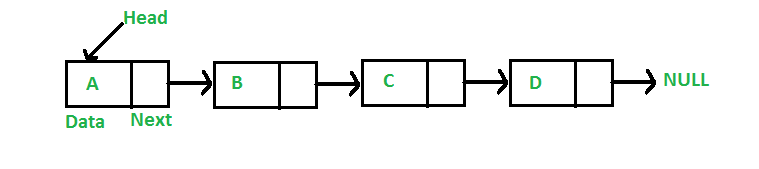
In simple words, a linked list consists of nodes where each node contains a data field and a reference(link) to the next node in the list.
Like arrays, Linked List is a linear data structure. Unlike arrays, linked list elements are not stored at a contiguous location; the elements are linked using pointers.
Why Linked List?
Arrays can be used to store linear data of similar types, but arrays have the following limitations.
1) The size of the arrays is fixed: So we must know the upper limit on the number of elements in advance. Also, generally, the allocated memory is equal to the upper limit irrespective of the usage.
2) Inserting a new element in an array of elements is expensive because the room has to be created for the new elements and to create room existing elements have to be shifted.
1) The size of the arrays is fixed: So we must know the upper limit on the number of elements in advance. Also, generally, the allocated memory is equal to the upper limit irrespective of the usage.
2) Inserting a new element in an array of elements is expensive because the room has to be created for the new elements and to create room existing elements have to be shifted.
Key Differences Between Array and Linked List:
1. An array is the data structure that contains a collection of similar type data elements whereas the Linked list is considered as non-primitive data structure contains a collection of unordered linked elements known as nodes.
2. In the array the elements belong to indexes, i.e., if you want to get into the fourth element you have to write the variable name with its index or location within the square bracket.
3. In a linked list though, you have to start from the head and work your way through until you get to the fourth element.
2. In the array the elements belong to indexes, i.e., if you want to get into the fourth element you have to write the variable name with its index or location within the square bracket.
3. In a linked list though, you have to start from the head and work your way through until you get to the fourth element.
4. etc

Comments
Post a Comment